


If you are reading this, it is highly likely that you have eyes, and that those eyes are face-mounted, meaning they are set in your head. The reason why humans and so many other animals have face-mounted eyes is due to a process called cephalization. This is the process whereby sensory organs, nerve cells, and the mouth become concentrated at the anterior of a creature’s body. However, not every animal that has evolved needs a head to see. There’s a plethora of animals that are able to perceive light and movement even though they lack a conventional-looking head. Before looking at some of these animals, let’s understand why this phenomenon occurs. There’s quite a bit of fascinating evolutionary science behind it!
Why Don’t Some Animals Have A Head But Can See?
Animals without heads generally have what is known as Radial Symmetry. In simple terms, it means that they are shaped like wheels or pies. This enables their bodies to have a decentralized nervous system, which means that the nerves are spread out evenly throughout their bodies.
What is more, these animals also lead a relatively sedentary life. Having a decentralized nervous system allows them to have a 360-degree awareness of their environment, making them better able to tackle threats.
Furthermore, these animals are quite passive at hunting. They mostly consume food that comes to them. Now, having and developing a dedicated head for a brain costs a lot of energy. Animals with centralized nervous systems are unable to get and store the amount of energy required for this task, evolutionarily leaving them without a head.
Also Read: Best Aquariums To Visit In India: Top Places To See Sea Creatures!
5 Animals That Can See Without A Conventional Head
1. Scallops (Pecten jacobaeus), The Biological Telescope Array
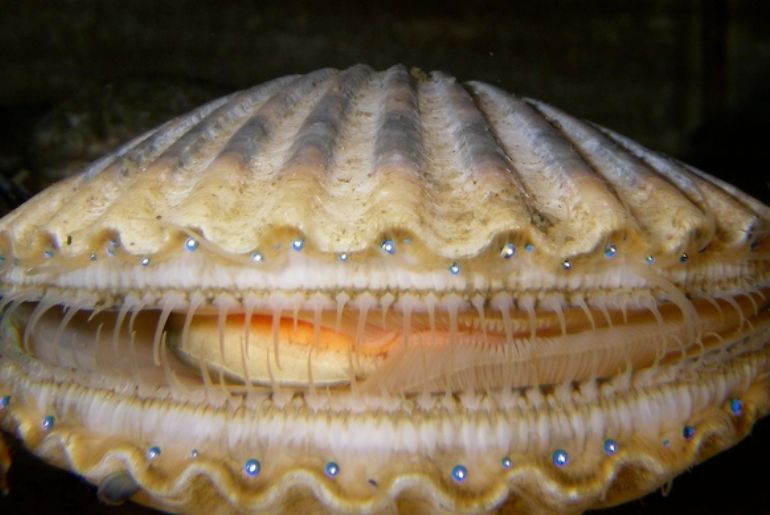
Anatomy: Scallops lack a head or brain. Yet, they possess up to 200 bright-blue eyes embedded along their fleshy mantle edge.
How It Works: Human eyes use protein lenses to focus light. However, this is not the case with scallop eyes. They instead use microscopic guanine crystal mirrors to reflect light on a double-layered retina. These eyes rapidly detect shadows and movements of nearby predators (like starfish). This triggers a swimming escape in the scallops done by clapping their shells.
2. Starfish (Asteroidea), Eye-Tips On Every Arm
Anatomy: Starfish display radial symmetry around a central disc, and they are completely lacking a head or centralized brain. At the tip of each of their arm sits a compound eye composed of 50 to 200 individual optical units (ommatidia), similar to insect eyes.
How It Works: These eyes provide low-resolution, slow-frame-rate vision that helps them navigate back toward dark, protective coral reefs whenever they are swept away by the undertow.
Also Read: Underwater Aquarium in Mysore: Tickets, Timings & Fees
3. Sea Urchins (Echinoidea), The Whole-Body Eyespot
Anatomy: Sea Urchins are headless echinoderms and are encased in a spiny spherical shell. Urchin was the old word for hedgehogs, which is why these creatures are called sea urchins.
How It Works: Sea Urchins express photoreceptor proteins (opsins) across their outer skin surface. Their long, opaque spines act as directional light shades. They block ambient rays and effectively turn the organism’s entire body into a single, high-contrast eye. This helps them spot approaching shadows, head toward dark shelter crevices, and point protective spines toward threats.
4. Box And Moon Jellyfish (Cnidaria), Complex Optics Without a Brain
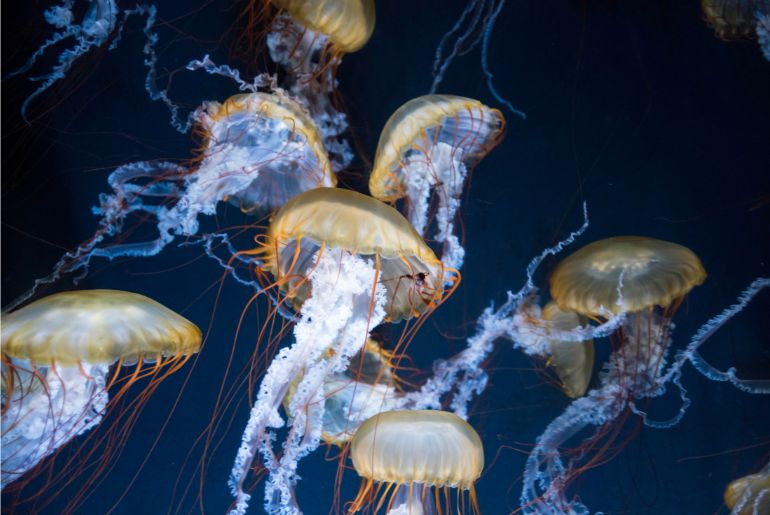
Anatomy: Box and moon jellyfish have bell-shaped bodies and no head, real brain, or even a central nervous system.
How It Works: Jellyfish have something called Rhopalia. These are sensory centers that are suspended around the rim of their bell and have true upper and lower lens eyes, complete with corneas and retinae. They have as many as 24 eyes across four rhopalia. The upper eyes look up through the water surface to navigate using mangrove tree canopies, while lower eyes help in detecting obstacles and prey.
5. Brittle Stars (Ophiuroidea), Living Optical Armor
Anatomy: Brittle stars are relatives of sea stars. They are more arm-dominated and also lack a centralized head.
How It Works: Brittle stars have outer skeletal plates that are made out of microscopic calcite crystal spheres. These spheres act as the perfect optical lenses and focus light onto underlying nerve pathways. Doing this turns their skeleton into a giant, distributed visual array that instantly senses environmental light changes. It also allows them to retreat into dark rock crevices within milliseconds when exposed.
Also Read: Underwater Aquarium In Bangalore: Explore India’s Biggest Aquarium
Summing Up
While human vision relies heavily on having a centralized head and brain. However, nature and evolution have created a number of ingenious ways by which creatures can perceive light and see the world without having a conventional head. The world is filled with incredibly diverse lifeforms. Evolution has shaped the formation of creatures in such a way that it is almost impossible not to feel in awe of it. It is also why, for ages, people have concluded that there must be some intelligent designer intentionally creating such ingenious ways of surviving the world we live in.