Video: Woman Travels 4 Days In Indian Railways' General Coach, Shares Her Safety Experience
A woman shares her experience of traveling for 4 days in an Indian Railways general coach, prompting conversations about passenger safety.
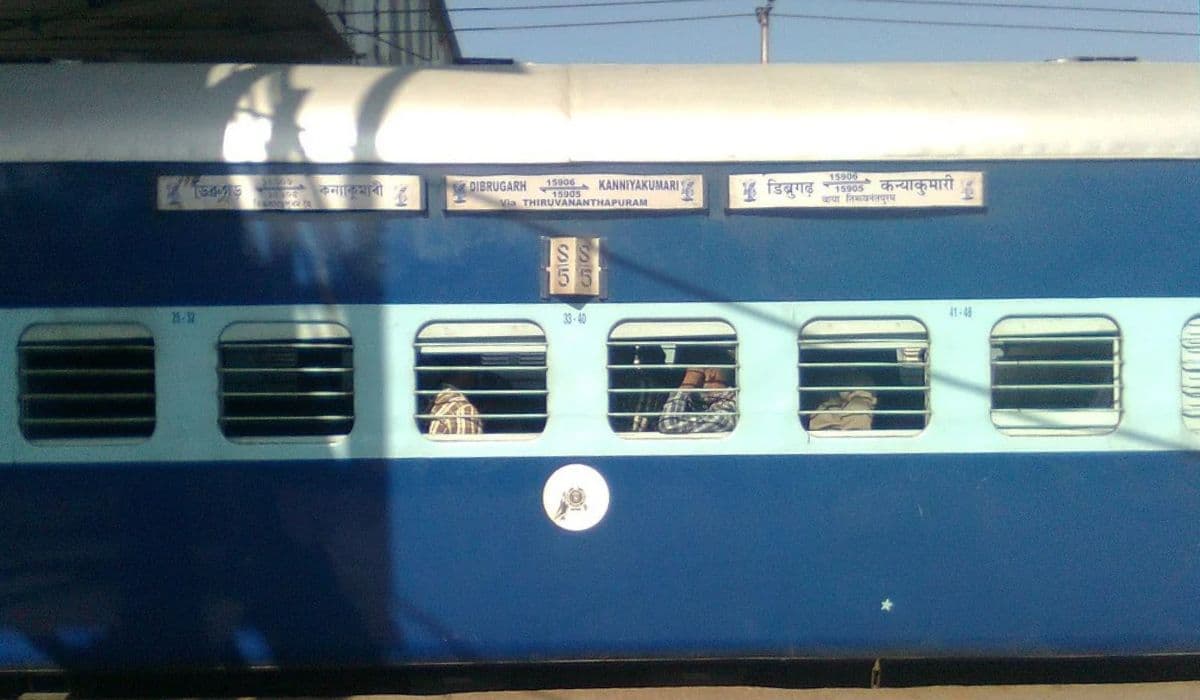
Vivek Express | Image Credits: Wikimedia Commons
Indian Railways is famous for being equally accessible to all. While that may be true on paper, travelers often encounter infrastructural failures that prevent this on-paper equality from becoming a material reality. Recently, a YouTuber and National Award-winning content creator, Keerthi Govindhasamy, took the longest train journey in India from Kanyakumari to Dibrugarh in the Vivek Express. She took the unreserved General compartment to investigate the ground reality of Indian Railways and its unreserved general compartment. Here is her experience.
India’s Longest Train Journey: 4 Days In Indian Railways’ General Coach
Govindhasamy’s question when embarking on this odyssey was simple: What does it take to travel this way as a woman, and what does the ticket price decide about safety, dignity and basic comfort?

Vivek Express AC Compartment | Image Credits: Railinfo
The Vivek Express covers a staggering distance of about 4,155 km to 4,188 km in around 75 hours, as per official records. Govindhasamy’s journey went on for around 92 hours, which is around four days.
What The General Compartment Is Like
The price for a ticket in the unreserved general compartment for the entire trip is around INR 630 to INR 730. Passengers there hold tickets without seat numbers and take whatever space they can find. As such, people end up sitting on floors and in aisles, and some even end up near the toilets.
While Govindhasamy ended up finding a seat that was not near the toilets, she said that she had to sit in one position for nearly 15 hours at a stretch. Owing to the intense crowd, reaching a toilet or dustbin through the crowd was difficult. What made things worse was that the coach was made for carrying 60 people. However, it was carrying way beyond its capacity.
Safety Concerns On The Journey
Fortunately for Govindhasamy, she was traveling with male colleagues during the journey. She credits this fact as the reason she was more or less protected on the train. Despite this, she recounted several instances where she felt unsafe.
In one of the instances she showed, a man is seen deliberately pressing his leg against hers. Another man is seen repeatedly standing outside her window at stops and doing things that made her uncomfortable. She even shows glimpses from a confrontation that grew into a larger argument, until nearby passengers stepped in on her side.
Throughout these instances, she says her dominant thought was what would happen to a woman traveling alone without a camera or teammates. Nobody who “does not have anyone to assist” can count on the same backup, she said.
Why Complaints Are Hard In General Class

Exterior of Vivek Express | Image Credits: Reddit
Readers eager to defend the system might point out that the railways have emergency helpline numbers posted at various locations that one can contact if an unsavory situation arises. However, the video also highlights many structural difficulties with this “solution”:
The biggest loophole that the video points out is that the railway complaint channels such as the helpline 139 and the Rail Madad portal and app generally ask for a PNR number. However, unreserved tickets do not carry one.
Govindhasamy did note that Rail Madad does accept the UTS number printed on a general ticket. However, she said that the system still struggles to locate a passenger who has no coach or seat number.
She then harkened back to the chilling incident that took place around four weeks ago wherein a 20-year-old Himashree Boro died after reportedly feeling unsafe. She said help could not find the woman because the complaint did not name her coach.
Toilets, Water And Hygiene
Another major recurring issue was the lack of basic sanitation facilities. Govindhasamy reported that there was no water in the toilets, and people sitting near the entry of the toilets made it even harder to use them.
The worst part was that there was absolutely no cleaning done in the compartment for the entirety of the four days that the train was plying. Dustbins filled quickly and waste was thrown out of windows. She also noted that this happens in AC coaches, where passengers have more room to walk.
Owing to these circumstances, she had to refrain from using the toilet till it was very necessary, and because of this, she later reported that she developed an infection. Govindhasamy did not blame passengers. Her argument was that the facilities provided for them are what should be questioned.
Who Actually Travels in General Class
Some defendants might feel all too inclined to recommend foregoing traveling in the unreserved general compartment altogether and instead, travel either by other means or in other reserved compartments. However, this recommendation might be suited for people traveling for vacation or recreational purposes. But are these the people who take the unreserved general compartment for long distances?
Most people she met were not on holiday. Many were migrant workers from Bengal, Bihar, Jharkhand, and Assam employed in Tamil Nadu and Kerala. These workers were heading home for festivals such as Durga Puja. She also met a nursing student traveling alone for the first time in the general compartment. She said she felt afraid but was going home for a family emergency. Many of these workers told her that they work far from home because wages are higher. One even said that he earns roughly double what he would in Bengal.
Cost drives the choice of train. One worker said a flight home would cost several thousand rupees more than the train, and those savings matter to his family, which might be the case for most, if not all, who were on the train at the time.
Moments Of Kindness
However, all was not doom and gloom on Govindhasamy’s journey. She also experienced moments of kindness that reaffirmed her faith in humanity. Strangers gave their seats up for her when the compartments were extremely crowded. Some guarded her belongings when she and her team had to step away. Some passengers traveling in the third AC even made space for her to sleep, with a blanket, pillow, and charging point.
Also Read: Bengaluru Goa Vande Bharat Express To Connect Udupi, Mangaluru, Gokarna And Goa
Summing Up
And this is the length and breadth of Govindhasamy’s journey. For her, the experience came down to safety, hygiene, and access to help. These basics, she claims, should not depend on how much money someone has. Especially not in trains, which are widely considered the symbol of national integration made manifest.
You can watch the full video on Keerthi Govindhasamy's YouTube Channel.
Frequently asked questions
Is Vivek Express the longest train?
Yes, the Dibrugarh–Kanniyakumari Vivek Express is the longest train route in India in terms of both distance and travel time.
What is the route of Vivek Express?
The Dibrugarh–Kanniyakumari Vivek Express (Train numbers 22503 / 22504) is the longest train route in India and the entire Indian subcontinent and travels from Dibrugarh (Assam) to Kanniyakumari (Tamil Nadu).
Is Vivek Express good or bad?
Traveling on the Vivek Express (specifically the Dibrugarh–Kanyakumari route, India’s longest train journey covering over 4,000 km across 4 days and 9 states) is generally considered challenging and low-rated by regular passengers, though it remains an iconic bucket-list adventure for rail enthusiasts.
- Published:
- Updated:
About the author
Tooba Shaikh
Tooba Shaikh has over three years of experience in writing and editing long-form, SEO-friendly content, mainly in the food and travel niche. She has previously worked with Curly Tales and is skilled with CMS like WordPress. To put it simply, not only does she make sure that your content sounds flawless, but also that it is actually visible to relevant audiences. You can connect with her on: Email: tooba.shaikh@moes-art.com