
India is a diverse country, and that is commonly known. But people, more often than not, do not realize how vast and diverse our country truly is. The Pang Lhabsol festival in Sikkim is a testament to this. It is a unique festival celebrated by the Bhutia and Lepcha communities in Sikkim. It not only renews brotherhood between the communities, but also honours the majestic Mount Khangchendzonga, or Kanchenjunga, as their guardian. If you are in Sikkim around August, the celebrations and festivities are unmissable. This holds doubly true if you enjoy witnessing new cultures and their celebrations!
What Is Sikkim’s Pang Lhabsol Festival?
In classical Tibetan, Pang means ‘to witness,’ Lha means ‘deity,’ and sol means ‘to worship.’ The name of the festival therefore tells you what it is about at its core. The festival honors the humongous mountain as the guardian and protector of the region.
Furthermore, the festival also has an important social and communitarian aspect. The festival also celebrates the bond between the Lepcha and Bhutia communities, and promotes peace, solidarity, and brotherhood between the indigenous tribes.
The festival typically takes place in the seventh Lunar month of the Tibetan calendar. This usually falls around August and September. This year, the festival is taking place between August 21, 2026, and August 28, 2026.
Also Read: How To Plan A Trip To Sikkim: Permits, Best Time, Budget And Itinerary
Why Is Pang Lhabsol Festival Celebrated In Sikkim?
There are two perspectives regarding the origin of the Pang Lhabsol festival. One is religious and mythological, and the other is more social and political. The latter is more about how the alliance between the two communities came about.
Religious And Mythological Origins Of Pang Lhabsol
Mount Khangchendzonga has long been revered as a guardian of the region by the indigenous Lepcha tribe. The local religions worshipped the mountain as the divine origin of their ancestors. However, when Buddhism arrived in the region, things took a turn.
In the 17th century, the patron saint of Sikkim, Lhatsun Chenpo (Lhatsun Namkha Jigme), meditated in the caves of Dzongri in West Sikkim. He was a Buddhist priest of the Nyingma tradition of Buddhism. If the legends are to go by, the mountain deity Khangchendzonga appeared before him in a grand vision. He guided the saint through secret mountain passes to open the hidden valley of Demajong (Sikkim).
After that, Saint Lhatsun Chenpo formally declared Khangchendzonga as the Dzo-nga, meaning the Five Treasures of the Great Snows. The mountain was then also officially consecrated as the eternal military and spiritual protector of the realm.
Social And Political History Of The Alliance Between Lepcha And Bhutia Communities
As per local history, around the 13th and 14th centuries, several Bhutia migrants settled around Kabi Lungchok. This subsequently gave rise to tensions between the two communities of Lepcha and Bhutia. In order to put an end to these tensions, the leaders of the tribes met and made a treaty at what is now the historic site of Kabi Lungchok. It is located roughly 17 km north of Gangtok.
The two leaders, Thekung Tek of the Lepchas and Khye Bumsa of the Bhutias, erected sacred stone monolithic structures. They proceeded to pour animal blood and local spirits on the soil and swore an everlasting oath of unity and peaceful co-existence.
They also entreated the mountain god to strike down anyone who ever threatened to break this covenant of brotherhood. Today, the festival serves as a renewal of this covenant between the Lepchas, Bhutias, and Nepalis.
ALSO READ | Why Sikkim Is The Only Fully Organic Indian Destination
How Is The Pang Lhabsol Festival Celebrated?
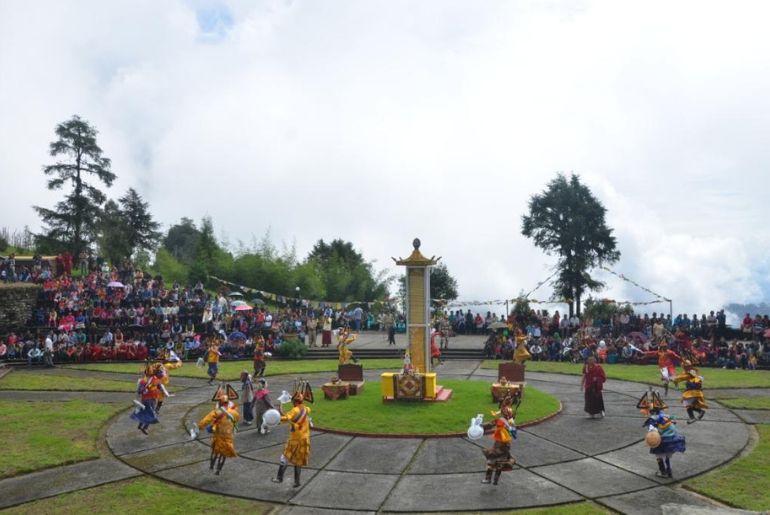
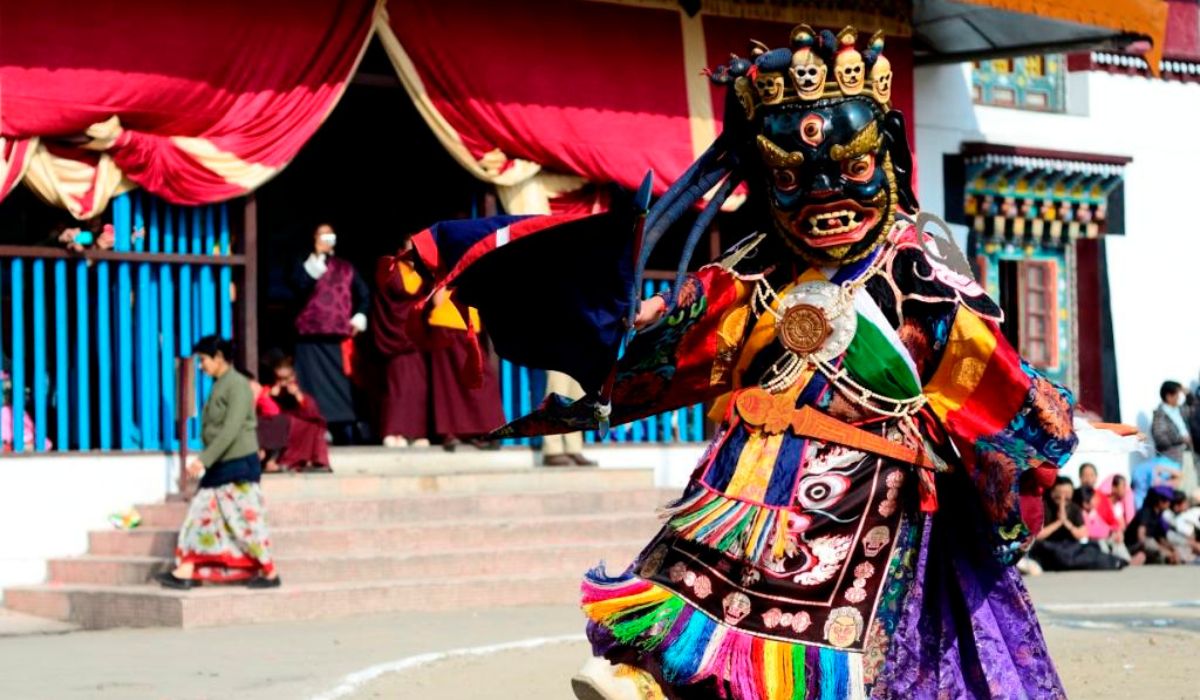
One of the most spectacular aspects of this festival is the dramatic warrior dance, known as Pangtoed Chaam. Dancers adorn intricate costumes and perform a vibrant dance that tells the tale of the culture. Legend has it that the third Chogyal (King) of Sikkim, Chador Namgyal, who reigned between 1700 and 1717, introduced the unique Pang-Toed Chaam dance after receiving a vision in his dreams. Here are the characters you will see featured in the dance:
- Dzonga (Khangchendzonga): The mountain god portrayed by a dancer wearing a fiery red mask. The mask is typically crowned with five human skulls and miniature flags that represent the snowy peaks of the mountain range.
- Yabdu: This is the fierce commander who is typically portrayed wearing a jet-black mask. He is usually seen as the minister and companion of Khangchendzonga.
- Mahakala (Gonpo): Mahakala is the wrathful protector of the Dharma. He is the one who commands the mountain deities to defend their peace and justice.
- The Warriors: These are typically young monks clad in traditional Sikkimese battle attire. Their adornments consist of brass helmets, broadswords, and shields, and they perform a breathtakingly fast-paced martial acrobatics act to the thunder of cymbals and long horns (Radung).
Where To Witness The Celebration
1. Tsuklakhang Monastery, Royal Palace Complex, Gangtok
The Tsuklakhang Monastery is arguably the most famous site of Pang Lhabsol festivities. It features public performances of the Pang-Toed Chaam on the central lawns.
2. Norbugang Or Yuksam And Pemayangtse Monastery, Gyalshing District
The festivities in the Gyalshing district play host to deep-rooted ancestral rituals. There are pilgrimage treks to Dzongri as well as the annual motorcycle rally tribute that happen as part of the Pang Lhabsol festivities.
3. Ralang Monastery, South Sikkim
The famous Ralang Monastery also observes the Pang Lhabsol festival. It is renowned for its traditional, serene monastic observances. This place is perfect for those who want a more tranquil and reflective experience of the festival.
Also Read: Do Indians Need Permits To Visit Sikkim? Inner Line Permit For Sikkim Explained
Author’s Note
Here are a few things I would advise the readers to be particularly careful about. You should carry your valid photo ID, just for safety. You never know when and where you’ll be in need of it. The ceremonies are quite vibrant and unlike anything that people from other parts of India might have seen before.
As such, the urge to click photographs is extraordinarily strong. However, it is better to refrain from doing so excessively. You can take as many pics as you like on the lawns; however, inside the temples and monasteries of Sikkim, it is better not to touch your phone or cameras at all.
Furthermore, you should avoid clicking photos during sacred monastic chants and incense offerings, as that, too, is strictly prohibited.
Summing Up
Pang Lhabsol is one of the most unique festivals that India has. It is a reminder of how diverse India as a country truly is and how rich our local heritage is. Those who are planning to visit Sikkim during Pang Lhabsol should be mindful of local customs and be respectful of them. Refrain from photography wherever prohibited and always check whether your outfit is appropriate for the ceremonies.