

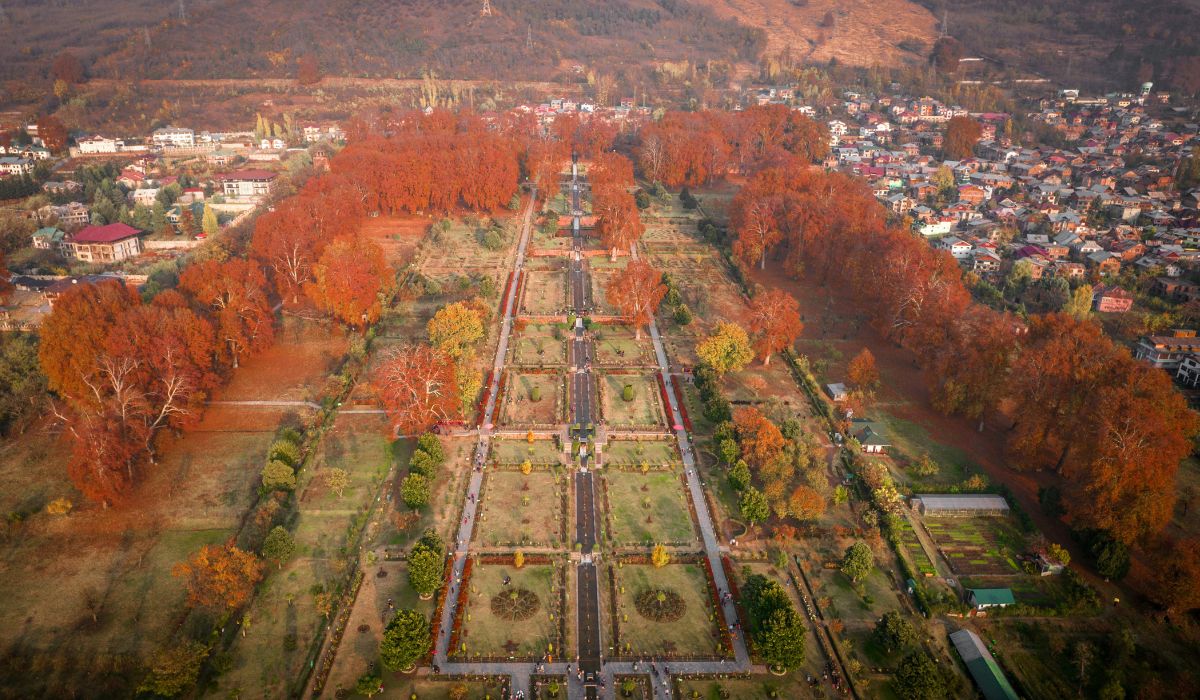
Known locally as Boehne, Chinar trees or the Oriental Plane tree (Platanus orientalis) were introduced and nurtured across the valley by Mughal emperors. These Mughal emperors had vast groves planted for shade and royal courts, as well as aesthetic garden layouts. Today, these very Chinar trees provide a lush green canopy during spring and summer. What adds to the already dramatic scenery is that they also undergo a world-famous transformation from late October through mid-November. The leaves of Chinar trees turn into vibrant shades of amber, gold, deep orange, and crimson red. Witnessing this transformation can be memorable for your Kashmir trip. If you, too, want to see these exceptionally beautiful trees, these are a few places where you can find the best Chinar trees in Kashmir.
Best Chinar Trees In Kashmir
1. Naseem Bagh (Garden Of Morning Breeze), Srinagar
The Chinar trees in Naseem Bagh, located near the University of Kashmir campus, were planted by Emperor Shah Jahan in 1635. This is the largest single Chinar grove in the valley, and it houses more than a thousand mature trees, and some of them line the banks of Nigeen Lake. Imagine taking in this view as you walk on a thick carpet of rustling orange leaves within the University of Kashmir campus.
Timings: 8 AM to 6 PM
Entry Ticket: Free
2. Char Chinari Island, Dal Lake
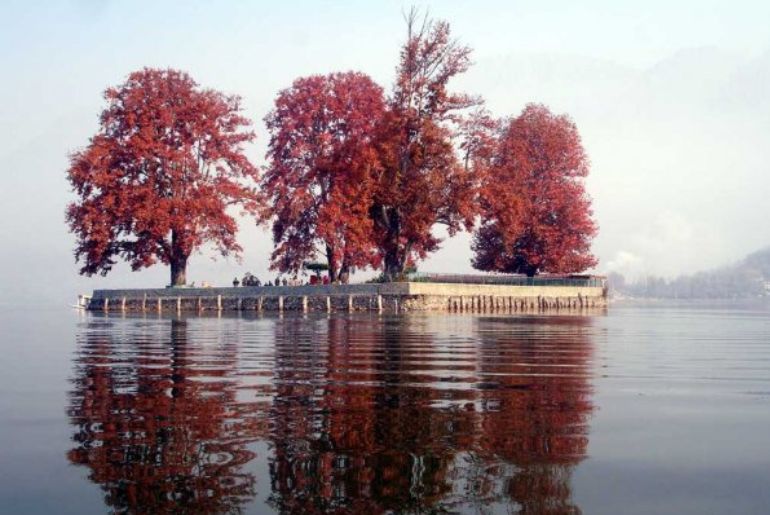
Char Chinari Island is a tiny but renowned island on Rupa Lank in the middle of Dal Lake. It was commissioned by Murad Bakhsh, who was the brother of Aurangzeb. The island is famous for four symmetrical Chinar trees guarding its center. One of its distinctive features is that it can only be reached via a traditional wooden Shikara ride. This also offers unmatched 360-degree photography views framed by mountain peaks.
Timings: 6 AM to 6 PM
Entry Ticket: Free; boat costs may vary.
3. Nishat Bagh (Garden Of Pleasure)
Built in 1633 by Asif Khan, Nishat Bagh features 12 cascading terraces that are aligned with Zabarwan mountain views. Adding to this already impressive view are the massive and majestic Chinar trees flanking the stone channels and water fountains. The sunset views at this time are exquisite.
Timings: 7 AM to 7 PM
Entry Ticket: INR 30 per person
Also Read: Kashmir Tulip Garden 2026: Complete Travel Guide, Best Time & Stay Tips
4. Shalimar Bagh (Abode Of Love)
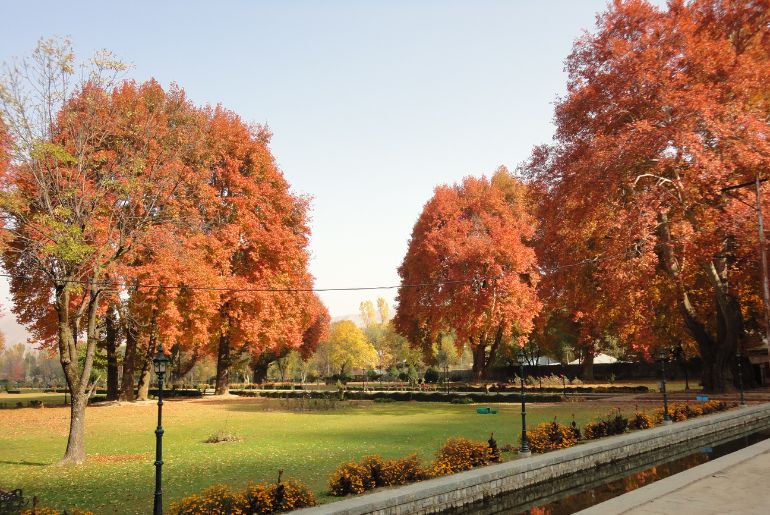
Shalimar Bagh is widely considered the crown jewel of Mughal gardens. It was built by Emperor Jahangir for Empress Noor Jahan in 1619. The intricate stone pavilions of the Diwan-i-Khas here are shaded by picturesque arches of the Chinar trees. If you’re a photographer looking to capture the beauty of autumn in Kashmir, you will be very happy with the views you find here.
Timings: 9 AM to 7 PM
Entry Ticket: INR 50 per person
5. Padshahi Bagh (Bijbehara), Anantnag
Officially designated as the “Town of Chinars,” Padshahi Bagh has the oldest surviving Chinar grove in South Kashmir. It was laid out by Prince Dara Shikoh in the 1640s. One of the Chinar trees here is estimated to be more than 500 years old! If you happen to travel via the Srinagar-Jammu Highway, this region is an essential stop. It offers a dense, quiet canopy walk away from major city crowds.
Timings: 9 AM to 5 PM
Entry Ticket: INR 30 per person
6. Pahalgam And Lidder Riverbanks
Pahalgam is another place where you can spot many Chinar trees. However, unlike the manicured garden layouts of Srinagar, Chinar trees in Pahalgam grow naturally along mountain streams and pine pastures. During the fall season, the bright red autumn foliage set against emerald river waters, and the early snow dusting on the surrounding Himalayan peaks, all create an unforgettable view.
7. Badamwari Garden And Downtown Srinagar Heritage Quarter
Located at the foothills of Hari Parbat Fort, the Badamwari Garden is famous for almond blossoms in spring and dense Chinar shade in autumn. You can enjoy strolling historic walkways here that are surrounded by classic Kashmiri woodwork and heritage trees in a tranquil urban setting. The downtown heritage quarter of Srinagar will particularly appeal to those who enjoy heritage walks.
Timings: 9 AM to 7 PM
Entry Ticket: INR 24 per person
Also Read: How To Reach Kashmir by Train, Flight And Road: Cheapest Routes
Author’s Note
I love clicking beautiful pictures and was keen on capturing the full glory of the Chinar trees. The best thing I did was go to Naseem Bagh early in the morning, around 7:30 AM, to capture the soft columns of sunlight passing through the leaves of the Chinar trees. If you, too, are similarly keen on clicking good photographs, you should do the same. There are minimal tourists, and you can enjoy the best, crowd-free hours by yourself.
Summing Up
The biodiversity of Kashmir, especially when it comes to flora, is quite breathtaking. The Chinar trees are part of what makes Kashmir so beautiful. They are especially beautiful during the period between October 20 and November 15. The leaves of the Chinar trees turn vibrant shades of gold and red. The weather, too, is quite cold and makes you feel as if you’re walking through the maple leaves of Canada.