Why Does Uttarakhand Celebrate A Second Diwali? Igas Bagwal 2026 Guide
Igas Bagwal falls on November 20, 2026. Discover why Uttarakhand celebrates a second Diwali and the traditions of bhailo, folk music and cattle worship.
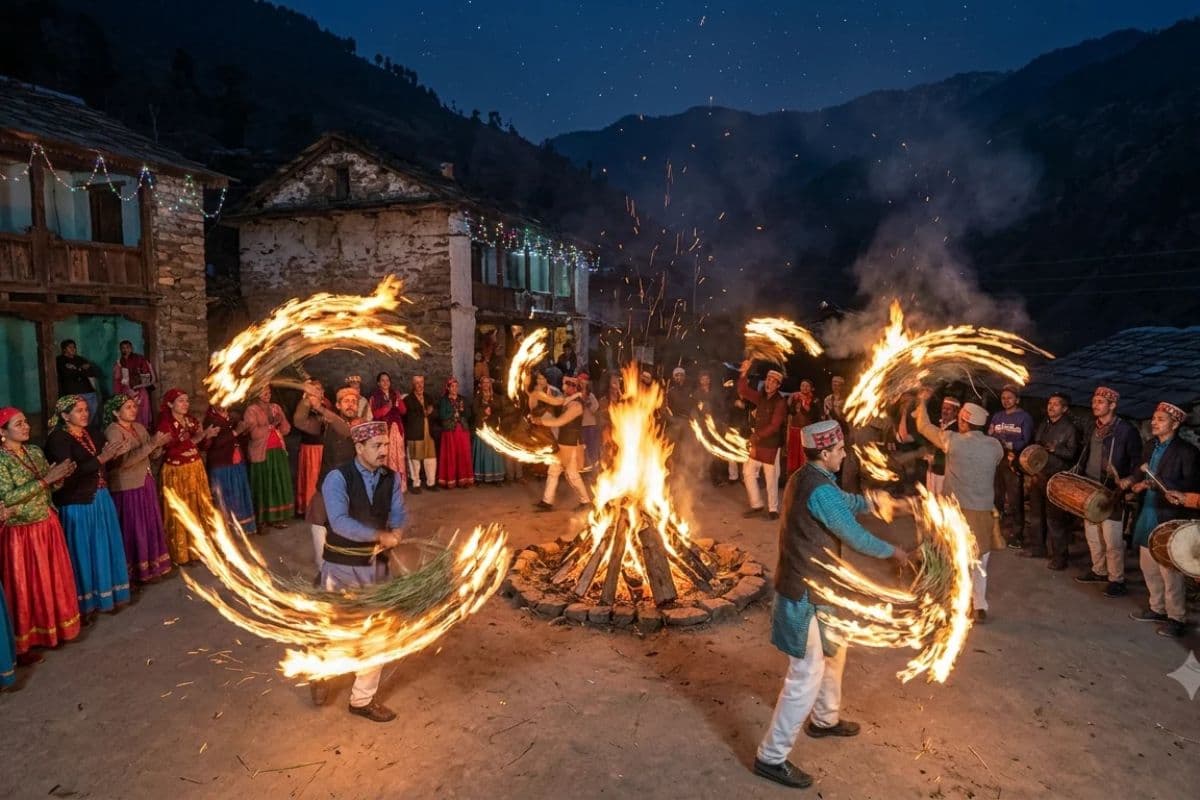
Villagers celebrating Igas Bagwal 2026 in Uttarakhand | Photo Credits: gemini AI
While the rest of India completes its Diwali festivities with Amavasya, the state of Uttarakhand is known for preparing for its festival of lights. This Diwali is known as Igas Bagwal, or Old Diwali or Budhi Diwali here, and is a centuries-old celebration that takes place right after Kartik Shukla Ekadashi, 11 days later. This year, Igas Bagwal is set to be celebrated on November 20. Let's understand the reason behind this celebration and learn more about this second Diwali celebrated in the high valleys.
Why is Igas Bagwal Celebrated?
The term Bagwal in the Garhwali and Kumaoni dialects means the festival of lights, and Igas means the 11th lunar day of the bright fortnight in the month of Kartik, or Ekadashi. To understand why Uttarakhand celebrates Diwali after 11 days, let's take a deep dive into the mythological legends.
Tale of Delayed News
According to local folklore, when lord Rama returned to his city, Ayodhya, after defeating Ravana, the news spread like wildfire across the plains (Indo-Gangetic). However, due to isolated ridgelines, formidable terrain, and lack of rapid communication, in the high Kumaon and Garhwal hills, the news reached the remote mountain hamlets, but eleven days late. As soon as the villagers received the news on Kartik Ekadashi, they illuminated their homes with pine torches and clay lamps, initiating the festival of lights after 11 days again.
Return Of General Madho Singh Bhandari
This local story revolves around the legendary 17th-century commander-in-chief of the Garhwal Kingdom under Chhatrapti Mahipat Singh, Veer Madho Singh Bhandari. He led a grueling expedition across the high-altitude Himalayan passes to defend the borders against Tibetan incursions. But as Diwali arrived, there was no news from the frontlines. Fearing something unfortunate, the Garhwal avoided all the festivities. On the 11th day after the Amavasya, Madho Singh returned with his army, and the overjoyed villagers lit oil lamps and prepared festive feasts.

Villagers celebrating Igas Bagwal 2026 in Uttarakhand | Photo Credits: Wikimedia Commons
Also Read: Golden Temple Amritsar: Timings, Entry Rules And Langar Details
Key Rituals Of Igas Bagwal 2026
Bhailo
This is the main ritual where villagers bundle the dried resinous pine wood and dry mountain grass tightly using natural hemp ropes. At dusk, the villagers light these bundles and swing them in the air in a circular motion.
Pashu Pujan
Oxen and cows are washed, their horns are rubbed with mustard oil, and they are adorned with marigold garlands. They are fed a special festive warm mash which is made of pulses, cooked rice, and coarse grains.
Dhol-Damau
The rhythmic beats of the traditional Garhwali instruments like Dhol and Damau fill the village. The villagers gather to perform community folk dances like Chhopati and Tandi.
Delicious Festive Cuisine
Every household features regional winter specialties like Pakora, Swala, Gahat soup, Arsa, and Jhangora kheer.
Also Read: What Is Diwali Marundhu? The Traditional Deepavali Food From Tamil Nadu
Guide For Igas Bagwal 2026
Event Details:
Date: November 20, 2026
Tithi: Kartik Shukla Ekadashi
Day: Friday
Regions: Best regions to experience this are the villages across Tehri Garhwal, Pauri Garhwal, Chamoli districts, and Rudraprayag and Uttarkashi.
Weather: Mid to late November brings crisp, dry autumn days which brings the temperature between 15 degree Celsius and 20 degrees Celsius. The temperatures during the night are between 2 degrees Celsius and 6 degrees Celsius in high-altitude villages.
Also Read: How To Spend A Day In Ahmedabad: 8 Experiences You Shouldn't Miss

Villagers celebrating Igas Bagwal 2026 in Uttarakhand | Photo Credits: Wikipedia
Tips For Travelers
The swinging of burning pine torches requires both skill and space. So make sure you observe and maintain a safe distance from the performers unless you are invited by the locals under their supervision.
Festivities begin after sunset and often extend late into the night around bonfire circles. Try to bring your thermal wear, woolens, and fleece jackets.
Village celebrations are very hospitable, so make sure you respect them and ask permission before clicking pictures so that you do not hurt their sentiments in any way. Keep this tip in mind, especially when you wish to film the villagers inside their private homes or during cattle rituals.
The ancestral village of General Madho Singh Bhandari, Rikholi, is known for hosting the most historically authentic Igas celebrations. Remote villages across the Bhagirathi and Bhilagna valleys host intimate celebrations where visitors staying at a homestay can participate in Pashu Pujan and relish delicious meals.
Also Read: How To Reach Juhu Beach From Mumbai Metro Line 3? Routes Explained
Summing Up
Igas Bagwal, also known as Budhi Diwali, is a festival celebrated in the northern state of Uttarakhand. It is celebrated 11 days after the Diwali celebrations take place across India.
Frequently asked questions
What is Igas Bagwal?
Igas Bagwal is a traditional festival of lights celebrated in the high valleys of Uttarakhand 11 days after regular Diwali.
When will Igas Bagwal be celebrated in 2026?
Igas Bagwal will be celebrated on Friday, November 20, 2026.
What is the main ritual performed during Igas Bagwal?
The main ritual performed during Igas Bagwal is known as Bhailo.
- Published:
- Updated:
About the author
Vaishalee Kalvankar
Vaishalee Kalvankar writes about travel and food for unstumbled. With five years of content and event management experience, she has worked at Curly Tales India, Curly Tales Middle East, Tit Bit Foods, Minority, and Seventy Seven Entertainment. She holds a postgraduate degree in media, entertainment, and marketing from KES Shroff College in Mumbai. Apart from writing, she is a traveller at heart who also loves dancing, drawing, and reading. Her expertise in festive travel recommendations and...
Related stories