
The capital city of Rajasthan is the perfect blend of rich cultural heritage and a modern cosmopolitan lifestyle. Jaipur, popularly known as the Pink City is famous for its stunning palaces, majestic forts, intricate architecture, and tranquil temples. The vibrant pink hues across the city structures and the colorful markets add to the city’s lively character. It has a lot to offer and if you’re planning a short two-day visit, then our 48-hour Jaipur itinerary has got you covered!
Places To Visit On Day 1
1. City Palace
We kick off the two-day Jaipur trip with the City Palace, which is known for its incredible history and architecture. The City Palace depicts Jaipur’s royal heritage and was the residence of the Jaipur royal family. The palace is an expansive property with several halls, gateways, museums, temples, gardens, and even smaller palaces located within it! It boasts a tasteful blend of European, Mughal, and Rajputana architecture, making the palace stand apart from other palaces in Jaipur.
Once you enter the City Palace, you will be greeted with huge gateways like the Tripoli (three gates), Udai Poli, and Virendra Poli. Interestingly, two of these gates are open for locals while one is reserved for the royal family. During your visit here, make sure to check out the Mukut Mahal, Chandra Mahal, Maharani’s Palace, and Mubarak Mahal, which are some of the highlight structures in the complex.
The Mubarak Mahal displays a unique collection of rich Pashmina shawls, unique royal costumes, Benarasi silk sarees, and dresses with Sanganeri prints and folk embroidery. The Maharani’s Palace is where you will find beautiful wall paintings and well-preserved Rajput weaponry.
Timings: 9:30 am to 5:30 pm Monday to Sunday.
Entry Fee: INR 200 onwards for adults, INR 100 onwards for children, and INR onwards 500 for foreign visitors.
2. Hawa Mahal
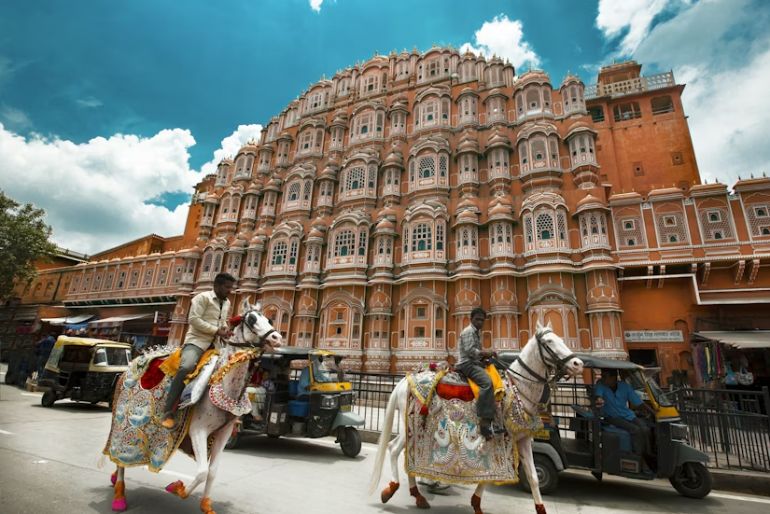
After exploring the City Palace, our next stop is the stunning Hawa Mahal. Considered to be one of the most iconic tourist attractions in Jaipur, this five-story palace’s structure resembles that of a honeycomb. The structure has amazing ventilation and you’ll certainly feel gusts of wind and breeze flowing throughout the palace, which earned it the name Hawa Mahal, literally meaning ‘Palace of Winds’.
This five-level building is the world’s tallest structure built without a foundation. Its curved architecture causes the stability that let it stand tall for all these centuries. The Hawa Mahal is one of Jaipur’s architectural marvels due to its superb blend of Rajput and Mughal architectural styles. You will see the domed canopies and fluted pillars from the Rajput styles, and the stone filigree work and perfect arches from the Mughal styles.
A fun fact about the palace is that its main purpose was to allow the ladies of the court and royal family to observe the streets of Johari Bazar from the many jharokhas (wooden framed windows) of the palace, without being seen themselves!
Timings: 9 am to 4:30 pm, Monday to Sunday.
Entry Fee: INR 10 onwards for Indian visitors and INR 50 onwards for foreign tourists.
3. Jantar Mantar
Close to the Hawa Mahal, is one of the oldest astronomical observatories – Jantar Mantar. The observatory is an epitome of architectural brilliance as well as an astronomical understanding of the Rajput era. Built in the year 1734, by Maharaja Jai Singh II for his keen interest in astronomy. The structure showcases various astronomical instruments made out of stone and marble. While the observatory is no longer functioning, it is frequented by historians, astronomers, architects, mathematicians, geographers, and tourists every year.
Jantar Mantar is now listed as a World Heritage Site by UNESCO. The 18,700 sq. meters property displays 19 astronomical instruments that complete Jantar Mantar. Each of these instruments was used for measuring the positions and distances of celestial bodies back in the day. Carved out of marble and stone, these tools illustrate various geometric shapes.
Jantar Mantar has everything from giant sundials to instruments that measure the elevation and angle of the sun and other planets!
Timings: 9 am to 7:00 pm, Monday to Sunday.
Entry Fee: INR 50 onwards for Indians and INR 200 onwards for foreigners.
4. Johari Bazar
After all the sightseeing, it’s time to indulge in some shopping! A shopper’s paradise, Johari Bazar is a must-visit market in Jaipur. And it takes no genius to figure out what this market is famous for – jewelry. Johari Bazar translates to ‘Jewellers Market’ and the lanes and by-lanes of this market are flooded with jewelers, jewelry shops, and stores. You will find a wide array of metal jewelry pieces, bedazzled pieces with precious and semi-precious gemstones that depict the rich Rajasthani culture.
The highlight of this market is the enticing gold, silver, diamond, emerald, and ruby jewelry which is carefully crafted in the typical Thewa and Kundan style. You’ll also see several jewelers and craftsmen sitting outside on the sidewalks with their workstations. Johari Bazar has several fabric stores selling lehengas, colorful printed and embroidered sarees, exquisite Jutis and Mojaris (traditional footwear), tie-dye, Bhandhani suits, and more.
A stroll through the market is enough to tempt you to purchase at least some souvenirs for family and friends and even yourself, before going back home!
Timings: The market vendors have their shops and stalls open from 10 am to 11 pm throughout the week.
Entry Fee: There is no entry fee to visit Johari Bazar.
5. Bapu Bazar
Bapu Bazar is another well-known marketplace in Jaipur and is quite close to Johari Bazar. So what better way to end your first day in Jaipur than with some more shopping? Bapu Bazar has a wide variety of shopping options from shoes, accessories, handlooms, metal works, to precious jewelry. The Bazar is equally popular among tourists and locals alike.
The market is a perfect place for a quintessential shopper as it has almost everything under the sun and it is sold at great bargain prices! And if you’re looking for traditional Rajasthani stuff, then a visit to Bapu Bazar is a must. Whether you wish to buy traditional Mojaris or Jaipuri quilts the market has them all. You will also find beautiful artificial jewelry, vibrant sarees and dupattas, and various handicrafts and showpieces here.
A small shopping spree will be the best way to end your day and these lively, colorful markets are the perfect setup for the same!
Timings: The shops and stalls in Bapu Bazar are open from 11 am to 10 pm, throughout the week.
Entry Fee: No entry fee is required.
Places To Visit On Day 2
1. Jaigarh Fort
We kick off day 2 with the sturdy and imposing structure of the Jaigarh Fort. The name translates to ‘Victory Fort’ and its main purpose was to protect the Amer Fort. The fort was built by Sawai Jai Singh II in 1726 for surveillance and defense of the Amer Fort. Located at an elevation of 500 feet above sea level, the structure provides the perfect eagle view of the surroundings. Fun fact–the fort is built atop the Hill of Eagles or cheel ka teela which certainly explains a lot about its purpose!
Jaigarh Fort exudes an imposing aura and has a similar architectural style to that of the Amer Fort. Made of the local red sandstone the fort boasts enormous walls and intricate, elegant carvings. You will also find several smaller structures within the fort’s complex such as the Lalit Mandir, Laxmi Vilas, Aram Mandir, and Vilas Mandir.
Jaigarh Fort has served as a residence for many kings and also stored artillery, weaponry, and ammunition. It also houses the world’s biggest cannon–Jaivana. The cannon is one of the major tourist attractions of the fort with a beautifully carved barrel depicting elephants, trees, and various birds.
Timings: The fort is open from 9:00 am to 5:00 pm, Monday to Sunday.
Entry Fee: INR 35 for Indians and INR 85 for foreigners.
2. Amer Palace
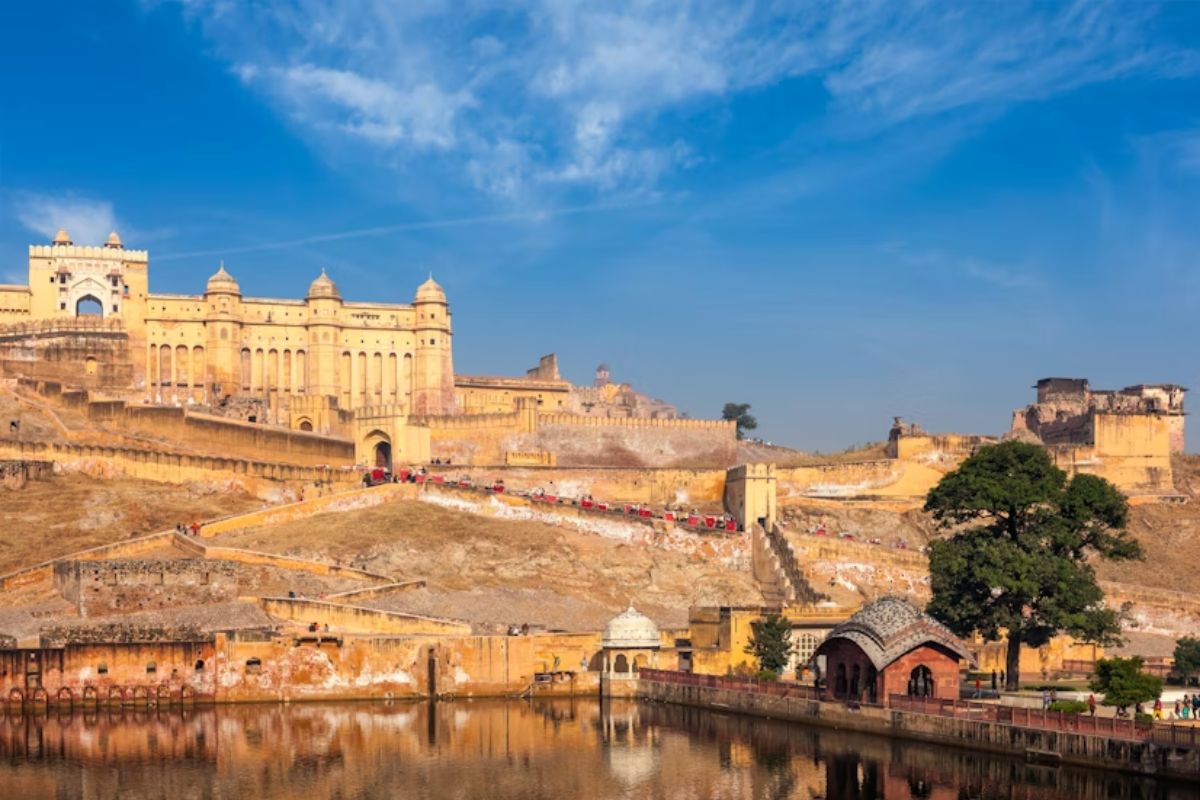
The final tourist attraction of our short Jaipur trip winds up at the Amer Palace. One of the most popular tourist attractions of the city, the palace is located 11 km from the city and sits atop a hill. The palace is stretched across an expansive area and is divided into four major sections, each with its courtyard. Built with pale yellow and pink sandstone and white marble, Amer Palace is simply an architectural beauty!
The palace has three massive gates – Suraj Pol, Ganesh Pol, and Chand Pol. Within the complex, there are several other structures and buildings such as Diwan-e-Aam, Diwan-e-Khas, Jaleb Chowk, Sheesh Mahal, Bhool Bhulaiya, and Zanana Dhyodhi to name a few. The entire complex is well-connected with underground tunnels and is also open for public viewing. Though the best way to enjoy the Amer Palace is the light and sound shows organized within the fort during the evenings which is a true spectacle that you must experience!
3. Nahargarh Fort
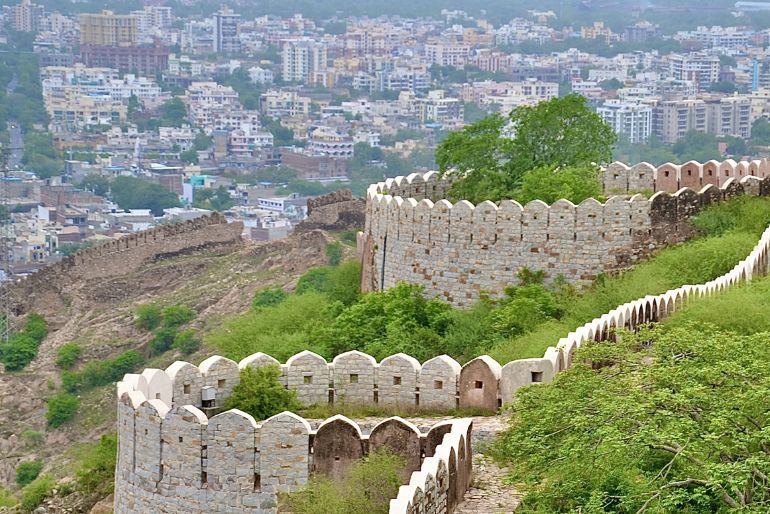
Post the Jaigarh Fort our next stop is yet another renowned fort of Jaipur – Nahargarh Fort. Set on the ridges of the Aravalli Hills, the fort is another one of Jaipur’s architectural marvels. Built to fortify the city, Nahargarh Fort is said to be over 700 feet high! It follows an Indo-European style of architecture and houses several smaller structures within it. From temples to gates to gardens to apartment chambers for kings and queens, the fort essentially had an entire township living in its quarters.
The Indo-European architecture is beautifully illustrated through the delicate frescoes that line the fort’s corridors as well as the delicate minakari work showcased in the hallways. You will also see elegant sculptures and statues of elephants, horses, and nature that add to the glamor of the fort. The halls and chambers in the fort display incredible Victorian paintings that boast fine craftsmanship.
The fort’s massive size and stature allow for a mesmerizing top view overlooking the glimmering city, making this one of the favored local picnic spots even today!
Timings: The fort timings are from 10 am to 5:30 pm every day.
Entry Fee: The entry fee is INR 50 for Indian visitors and INR 200 for foreign tourists.
4. Jal Mahal
Following the forts, our next stop is the Jal Mahal. Meaning ‘Water Palace’, Jal Mahal is constructed in the classic Rajput style of architecture, with Jaipur’s famous pink sandstone, all lined symmetrically. The palace seems to float amidst the Man Sagar Lake, and is an uber-popular tourist attraction for obvious reasons! Surprisingly, Maharaja Madho Singh I, who had the palace constructed in the first place, didn’t intend to use it as a palace! Rather it was used as a hunting lodge of sorts for the king and his ministers during their duck hunting expedition.
The palace is a testament to the innovation and creativity of the architects of that era, as the palace’s design is quite advanced and ahead of its time. While it appears to be a single-story building on the surface, actually it has four more levels that are submerged underwater! These levels hold millions of liters of water and the limestone mortar prevents water seepage onto the surface level. And it successfully has for over 250 years!
Timings: Jal Mahal opens at 6 am and it closes at 6 pm, throughout the week.
Entry Fee: There is no entry fee for a visit here.
Summing Up
Jaipur has so much to offer in terms of architecture, cultural experiences, food, and tourist attractions that you certainly need at least 4-5 days to cover the entire city. But if you’re looking for a short and sweet trip to dip your feet into what the city has to offer, our ultimate itinerary for 2 days in Jaipur will certainly be the perfect plan for you!
FAQs
What Is Jaipur Famous For?
Jaipur is famous for its majestic forts, regal palaces, mind-blowing architecture, rich culture, and heritage. The city is also well known for its Rajasthani jewelry, traditional fabrics and shoes, and bustling markets that house some beautiful ethnic souvenirs.
What Is The Best Time To Visit Jaipur?
The months between October and March are the best time to visit Jaipur. Since the weather is cool and super pleasant for sightseeing and exploration. However, you should pack some warmers as well since there is a drastic difference in the day and night temperatures.
What Food Is Famous In Jaipur?
Jaipur is famous for the popular Rajasthani dish Dal Baati Churma.
How Many Days Are Enough For Jaipur?
At least 4-5 days are recommended to enjoy a complete Jaipur experience. The city has numerous forts and palaces, temples, and scenic spots to explore. Though you can certainly visit the major attractions in a 2-day trip as well.
Which Language Is Spoken In Jaipur?
Hindi is the most spoken and official language in Jaipur. You will also hear some Marwari and English in the city depending on the area you’re traveling in.
Is Jaipur A Metro City?
Yes, Jaipur is a metro city and is India’s 6th metro rail system.