
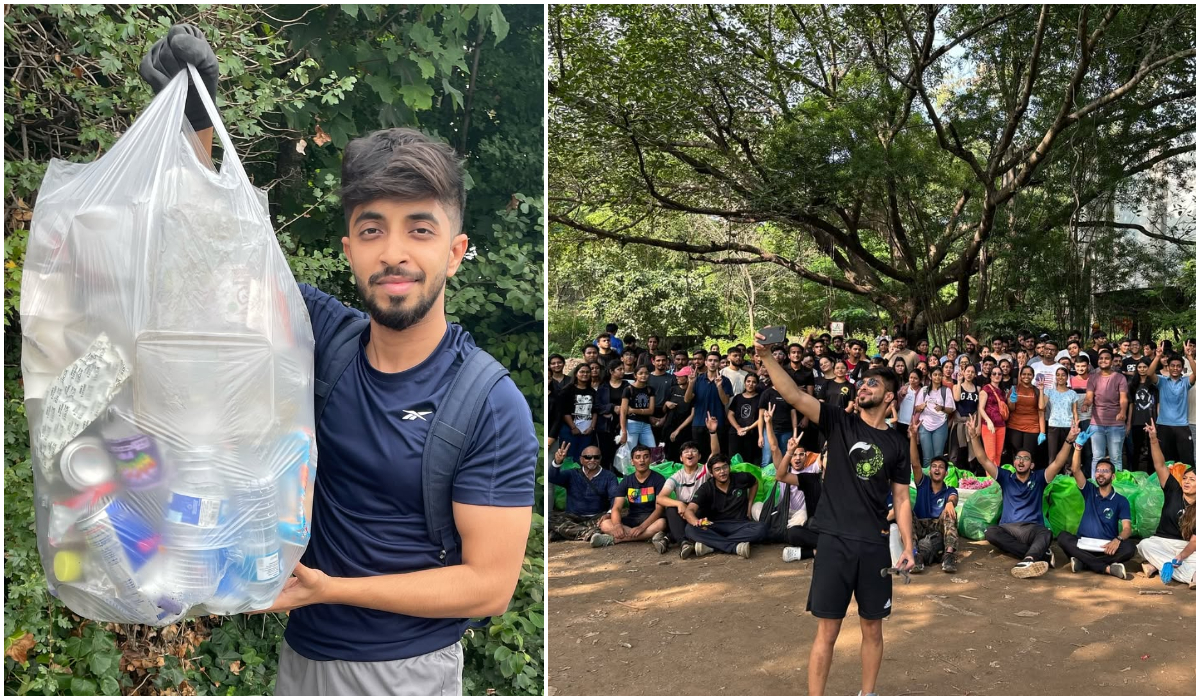
Cardio? Check. Community service? Check. Saving the planet one plastic bottle at a time? Also check! Meet Vivek Gurav, aka ‘Plogman’, the man making fitness a little less self-serving and a lot more sustainable by ‘plogging’. As the force behind Pune Ploggers, the world’s largest plogging community, he’s redefining what an early morning run can look like. We spoke to Vivek about plogging and his experiences, and why environmental change sometimes starts with simply showing up and picking up.
About Vivek Gurav And The Noble Cause Of Plogging
Vivek Gurav is a University of Bristol graduate, now based in the United Kingdom (UK). Hailing from Kolhapur, Maharashtra, he founded Pune Ploggers, the first plogging community in India, in 2019. Today, it has transformed into a global movement – being the world’s largest plogging community and inspiring 30+ global cities.
Vivek continues inspiring millions of ploggers around the world, and was awarded the UK PM’s Points of Light, one of the most prestigious awards in the country.
For those unversed, plogging is a combination of ‘picking up litter’ and ‘jogging’. It comes from the Swedish verbs for picking up litter (“plocka upp”) and jogging (“jogga”).
Erik Ahlström started the plogging movement in 2016 in the Swedish capital city, Stockholm. What started in 2016 has gone global today, thanks to leaders like Vivek Gurav who are taking this initiative to the masses and encouraging social responsibility on the grassroots level.
Here are excerpts from our conversation with Vivek Gurav.
In Conversation With Vivek Gurav AKA Plogman
Initial Days Of Pune Ploggers
unstumbled: Can You Take Us Back To That Moment When You Decided To Switch From Running As Usual To Running With A Cause?
Vivek Gurav: I found out about plogging when I began running and going for morning walks. And this was when I moved to Pune. I used to study at MIT Alandi, where I was pursuing engineering. I decided to explore plogging not only because it was beneficial for my health but also because it was beneficial for the environment.
unstumbled: What Did The Initial Days Looked Like When You Started ‘Pune Ploggers?’
Vivek Gurav: Starting a campaign – such as the idea of picking up someone else’s trash – was itself a big challenge. Unlike Western countries, where street trash is often just a piece of plastic, like a bottle cap or a chip packet, or glass, the trash in India consists of a lot of things, including food waste, unfortunately. Entering a trash dump and picking up waste out of that chaotic mix is also a big challenge. And this is the major reason why not many people choose to do it. So getting rid of that mindset of “why should I pick up someone else’s trash” was a major hurdle when we started.
So the best bet was to lead by example instead of waiting for people to change their mindset. And it worked! I’ve noticed that people are always passionate about working for social causes such as public cleanliness – all they need is for someone to lead and take the initiative.
Another major problem I faced was starting at a place like Alandi, where I was a newcomer. There are also system-related issues – from politicians and local leaders – especially when they see the youth stepping up for causes that mean the most to them.
unstumbled: What Are The Different Kinds Of Waste You Come Across?
Vivek Gurav: As previously mentioned, waste in India is a ‘chaotic mix’ of almost everything. Medical waste – used syringes, used cotton swabs, and even surgically removed body parts – is a significant part of the waste, and so is the waste generated from religious rituals.
Other kinds of waste we commonly find are broken furniture, glass items, single-use disposables, textile waste, and items that hold immense sentimental value. By that, I’m referring to flags and idols of deities and heroes.
unstumbled: How Is Pune Responding Today Compared To When You Just Began?
Vivek Gurav: Over the years, Punekars have shown immense love and support to the campaign. It started as Pune Ploggers with just 100 people on day 1. With each passing day, the word-of-mouth made the initiative more and more popular. It caught media attention, went viral on social media, and gained more traction among the internet audience.
The initiative launched in October 2019, and by 2026, we will have a base of around 20,000 active volunteers. My friends, hailing from different cities across India, loved my initiative and took this idea with them to their cities. Be it Mumbai, Nagpur, Sambhajinagar, or Nashik, the initiative grew quite well within Maharashtra. And not just Maharashtra, our idea picked up across the country – take the Patiala Ploggers in Punjab as an example! Kanpur Ploggers also stand out; in fact, they got appreciated by the Prime Minister Narendra Modi himself!
unstumbled: What Is The Frequency Of These Plogging Events?
Vivek Gurav: Most of our city chapters operate on a weekly basis – on every Saturday and Sunday. There are multiple other activities that we do, but we meet every Saturday and Sunday. And it’s consistently every single weekend, unless there are floods or heavy rainfall in the city, then we move into an indoor camp.
Sustaining A Global Community
unstumbled: What Are The Major Differences You Observe Between The Trash Produced In The UK Compared To India?
Vivek Gurav: Trash in the UK is mostly the ‘rich man’s trash’ – expensive alcohol bottles, cigarette buds, fancy glasses, unused electric items, and similar items. Most items thrown in the trash are usually single-use items.
In India, the trash is a diverse mix, as I previously mentioned. But what I appreciate about us Indians is that we have developed a culture of giving new life to traditionally single-use items. Think of the plastic beverage bottles that many moms use for storing water, or the plastic takeaway containers we use for storing things like chillies, corianders, and other ingredients.
Also Read: Redefining Resilience: How Ira Khan is Rewriting the Indian Mental Health Narrative
unstumbled: What Is The Toughest Part Of Sustaining A Global Community Like Pune Ploggers And Generally Spreading The Word Out There?
Vivek Gurav: I’d say being an Indian in itself is a matter of pride. We are looked at with a huge amount of respect and dignity, and it’s our soft power, I would say. Sustainability is our soft power.
In a world troubled by war and conflict, our initiative is like a ray of hope and positivity. And that’s where my campaign gained traction in the UK. I brought this campaign to the UK when I moved here to Bristol for my studies. So I’d say I used my identity for a noble cause – encouraging the people here to join this initiative.
As I studied here, I connected with people from diverse backgrounds – some were from Nigeria, Romania, Europe, as well as the United States. So it kind of became a global team that was plogging in the UK. We gained media attention and got people talking in the UK as well.
While I’m not the one who gave birth to this idea, I’d say I successfully brought it to India. PM Narendra Modi acknowledged this movement, and we were able to bring it to the grassroots by making it a people’s movement.
Practicing Sustainable Living & Future Goals
unstumbled: How Do You Practice Sustainable Living In Your Daily Life? How Would You Advise Someone Who Is Trying To Build Sustainable Habits In Their Life?
Vivek Gurav: Honestly, I should be the last person advising people on sustainability because I would say as much as I plog and promote the idea of sustainability, inculcating it in my own daily life has been a very big problem.
I try to live a very minimal life, but in the end, it’s always the trade-offs that come into play. I love traveling, and that produces a significant amount of carbon emissions. But then I also realized that if I don’t travel, I won’t be able to spread the word. And that’s when I came across the idea of traveling with a purpose; the idea of traveling without causing harm to the environment.
If there’s something that I want people to take away from this conversation, it’s the message that don’t try and give up on things that you really love doing because they could be causing harm to the environment. Pursue your passion, but try to inculcate small habits that contribute positively to the environment – or at least, aren’t irresponsible towards the environment.
To answer your question, I try to minimize my usage of single-use items as much as possible. I try to buy clothes from a thrift store to give existing clothes a second life. Of course, you cannot be ‘perfect’ while doing so.
unstumbled: If You Could Ban Like One Type Of Trash From Existence Forever, What Would It Be And Why?
Vivek Gurav: I usually avoid answering this question as I do not have any hard and fast feelings about any single thing in the world, but to answer your question, I’d ban food and water in plastic containers.
unstumbled: What Is In The Pipeline For Pune Ploggers And The Plogging Community That You’re Building Now?
Vivek Gurav: Pune Ploggers has changed – it isn’t something we created back in 2019. I do not look after Pune Ploggers in an actual sense, but it is an open community with people from all walks of life joining us. It has been taken over by our consistent volunteers, and I’m proud of them! Due to my personal and professional commitments in the UK, I do not manage daily operations.
It is not something that is owned by anyone or led by anyone, particularly. It’s a community of people working together towards a common goal.
We want to grow and bring in more corporate collaborations and take it global. We enjoy what we do, and we want to continue doing that.
Also Read: Redefining Resilience: How Ira Khan is Rewriting the Indian Mental Health Narrative