
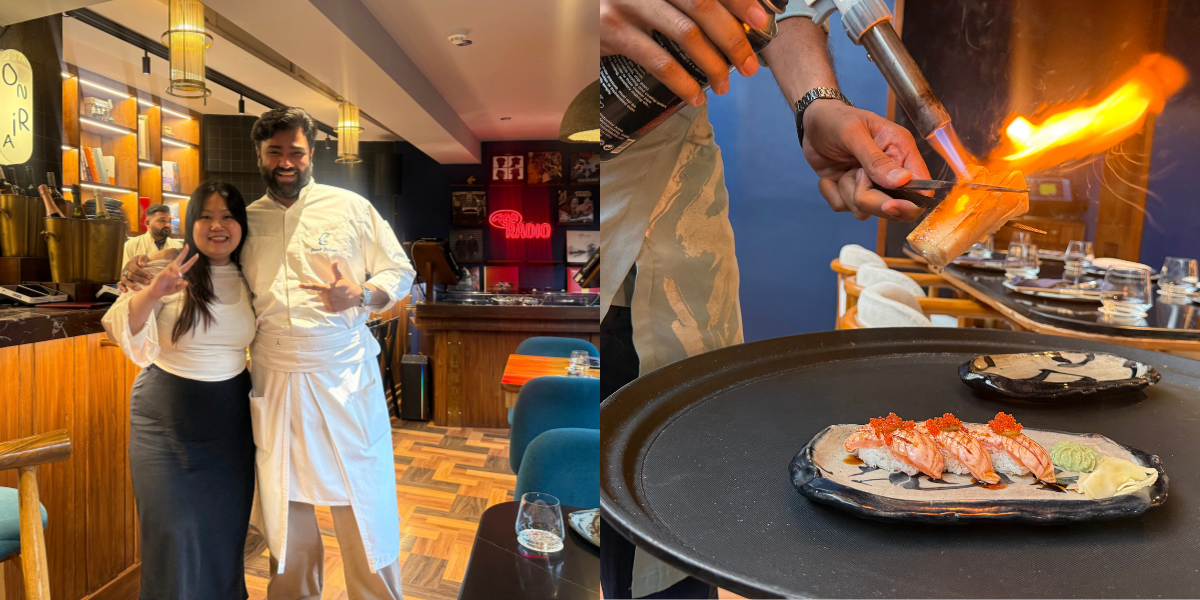
Mumbai’s ever-evolving dining scene has a new obsession, and it goes by the name Gaijin. From celebrities to the city’s inner circle, everyone seems to be making their way to this Japanese hotspot, and naturally, we had to see what the buzz was all about. Chef Anand Morwani’s brainchild, Gaijin has quickly become the city’s most talked-about table. Chef Anand gave us a tour of the space and also sat down for a one-on-one chat with team unstumbled.
In Conversation with Gaijin’s Chef Anand Morwani
1. You come from a family of doctors. Was there a defining moment when you realised the kitchen was where you truly belonged?
You know, I think I was brought up differently. Even though I come from a family of doctors, food was always the centre of our universe. It goes all the way back to my grandparents’ time, food was a big deal. Every Sunday, I would go to their house. My mother’s side is Maharashtrian, so it was a proper Maharashtra household. We used to have these beautiful thalis, and Sunday lunch would include every kind of protein, from mutton and fish to prawns, kheema, and kaleji. It was always a feast.
My parents, despite being doctors, loved entertaining. That really sparked my curiosity. To keep me busy, they would give me random responsibilities, organising the sound system, arranging lights, finding speakers on rent around Bandra. Slowly, it turned into planning entire gatherings, including coordinating with caterers.
What started as a way to keep me occupied ended up growing into something I truly loved. I think it was in 7th standard when I told my mom that I wanted to own a restaurant someday. Since then, I’ve just been figuring my way towards that dream.
2. Gaijin means a non-Japanese person or a foreigner in Japan. It’s such a beautiful concept—you’re essentially an outsider cooking Japanese food. How did this idea come to you?
When we established Gaijin, the idea was to embrace being outsiders, not shy away from it. That’s who we are. None of us were raised in a Japanese household, and collectively, we haven’t spent more than five years in Japan. So this felt like the most honest approach.
At the same time, I’ve always loved Japan, its culture, its food, everything about it. I’ve been fortunate to travel extensively and experience Japanese cuisine across the world, from Tokyo, Osaka, and Kyoto to cities like Dubai, London, Tel Aviv, New York, and even Hawaii. What I noticed is that everywhere, Japanese food adapts slightly to local preferences. For example, chefs like Nobu Matsuhisa added elements like warm oil to dishes such as hamachi carpaccio to make them more approachable.
With Gaijin, the idea wasn’t to recreate classics. I’ve done that all my life. The idea was to create original dishes inspired by our experiences with Japanese cuisine across the world. Our food is not just traditional, it’s contemporary, and that’s why the name Gaijin felt right.
3. You’ve explored food cultures in places like Tokyo, Tel Aviv, and Bali. What drew you specifically to Japanese cuisine as the foundation for Gaijin?
I think it’s simply my love for the cuisine. No matter where I travelled with my family, Spain, Italy, Portugal, or the US, we always made it a point to eat at a Japanese restaurant. It became a constant. I’ve always had immense respect for Japanese food. I was also fascinated by Japanese culture and comics growing up. Over time, I started experimenting with Japanese flavours in my own cooking.
What really excites me is the depth of umami in Japanese cuisine. At Gaijin, we try to amplify that while adding our own interpretation, balancing authenticity with experimentation, without ever compromising the integrity of the dish.
A great example is Kushi Katsu. I first experienced it in Osaka, in Dotonbori. Later, I came across a street vendor grilling Wagyu on charcoal, and that experience stayed with me. That’s how we created our dish Katsu vs Yaki at Gaijin, bringing together those two experiences into one.
4. At Gaijin, you balance authenticity with personal interpretation. How do you decide where to stay traditional and where to experiment?
It really comes down to the ingredient. When designing a dish, I focus on one key ingredient and build layers around it to enhance its flavour. Some ingredients allow for creativity and layering, while others demand restraint. For example, when working with Otoro (the fattiest cut of bluefin tuna), it’s important to do as little as possible. The quality speaks for itself.
Bluefin tuna offers three primary cuts—Akami, Chutoro, and Otoro—each with different fat content and texture. When we source such high-quality produce from Japan, the goal is to respect it, not overpower it.
At Gaijin, we prioritise sourcing the best ingredients globally. Whether you’re dining in Mumbai, London, or New York, the quality should feel consistent.
6. Was there a dish on the menu that took significantly longer to develop or perfect than the others? What made it challenging?
Every dish has its own journey. I usually sketch ideas, breaking them down layer by layer. Some dishes aren’t technically difficult but are extremely labour-intensive.
For example, our take on a Temaki (hand roll). Traditionally, it has to be served immediately because the nori softens quickly. I wanted to recreate it in a way that retains its texture even when served at a table.
So we developed a method to transform nori into a crisp, taco-like shell, without frying it. This gives it a longer-lasting crunch. We then layer it with rice, wasabi, marinated Akami, and finish it with Chutoro tartare, kizami wasabi, and a wasabi foam. It’s a complex, labour-heavy process, but the end result makes it worth it.
7. Your spaces have always been about more than just food—they’re about experience. How does that philosophy translate into Gaijin?
Hospitality is about the complete experience, from the moment you walk in to the moment you leave. The idea is to transport guests into a space where they can disconnect and feel taken care of. Food is at the core, but it’s not the only element. Service, ambience, music, and attention to detail all come together to create a lasting memory.
At Gaijin, a large percentage of our guests are repeat customers. While food plays a big role, it’s really the people—the team—that define the experience.
8. Cocktails are playing an increasingly important role in dining today. How have you approached the bar program at Gaijin?
I personally love exploring cocktail bars when I travel. I document everything—photos, notes, ideas.
When designing Gaijin’s bar program, our team travelled to Bangkok to experience global cocktail culture firsthand. That exposure helped shape a menu that caters to different palates and personalities. Our team of 3 people, tried over 120 cocktails in 5 days, it felt like Man vs Food and let me tell you, the cocktails won!
This led to us making signature drinks like Mount Fuji, which are designed as an experience—almost like a ceremony. Others, like In a Pickle, incorporate fermentation techniques, adding depth and complexity. At the end of the day, what matters is simple: would you come back for that drink? If the answer is yes, we’ve done our job.
9. What sets Gaijin apart from other restaurants?
What sets Gaijin apart is simply that it embraces being Gaijin. The focus is on creating original dishes rather than recreating classics. While you may find similar ingredients elsewhere, the interpretations here are unique. Dishes like Chutoro Carpaccio or Mushroom Tataki are experiences you’ll only find at Gaijin.
Beyond food, it’s the overall vibe—cocktails, music, service, and atmosphere—that defines the space. And putting a smile on people’s faces, at the moment, is what our job is.
Gaijin’s ambience
Tucked into the heart of the city, Gaijin makes an impression long before the first bite arrives. The moment you step in, the space draws you in with its refined aesthetic. At the centre sits a striking sculptural rock installation, grounding the restaurant in a quiet, almost meditative elegance. Gaijin is equal parts sophisticated and immersive, a space that feels thoughtfully designed rather than overtly styled.
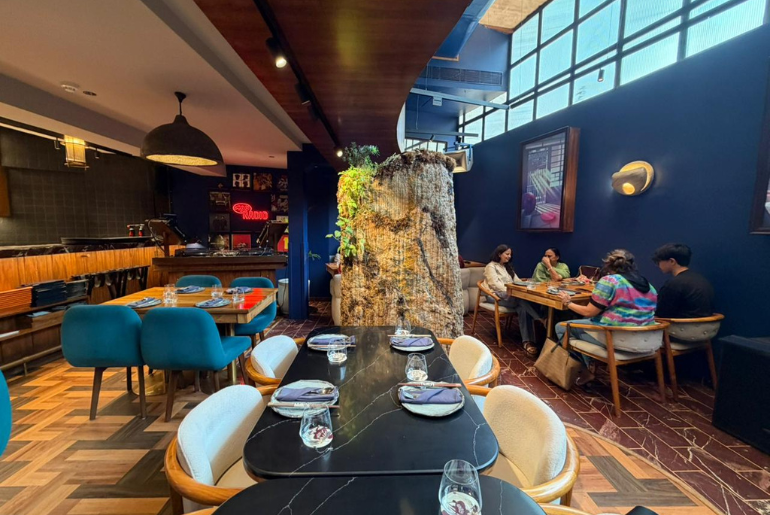
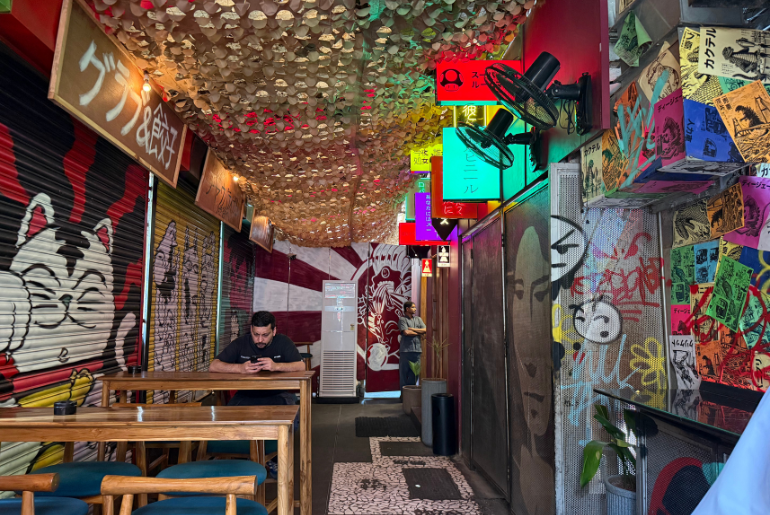
But just when you think you’ve understood the space, it surprises you. Hidden above the main dining area is an intimate nook, almost like a secret compartment, perfect for those seeking a more private experience. And then comes the real showstopper, a transformed lane that feels like a slice of Japan itself. Complete with a ramen cart, vibrant murals, and street-style detailing, this unexpected corner transports you from polished dining to the lively streets of Tokyo in seconds.
Gaijin’s menu
The experience, however, goes far beyond the setting. Despite not being a long-time admirer of Japanese cuisine, expectations were high and Gaijin delivered. The menu is a careful balance of precision and indulgence, with each dish showcasing both technique and quality.
We sampled a range of dishes, including Mushroom Tataki, Chutoro Carpaccio, Salmon Classic Nigiri, Salmon Gunkan, Pork Belly, and Bone Marrow. On the drinks front, the In a Pickle cocktail and Sakura Fizz mocktail rounded out the experience beautifully. What stands out immediately is the freshness, every element tastes considered, clean, and layered with intent. It doesn’t just replicate Japanese cuisine; it reinterprets it with confidence.
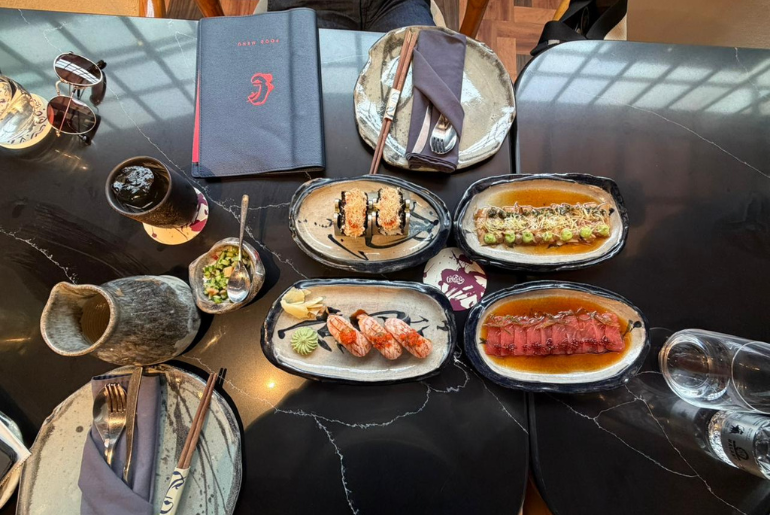
The Chutoro Carpaccio was easily one of the highlights. Delicate, rich, and impeccably presented, it featured some of the finest quality fish we’ve tasted in Mumbai. The Pork Belly followed closely, perfectly cooked, with a melt-in-the-mouth texture and a deep, smoky flavour that lingered just enough. The Bone Marrow, often a heavy dish, was surprisingly balanced, served with crisp accompaniments that cut through its richness effortlessly.
Summing Up
Gaijin isn’t just a restaurant, it’s an experience that unfolds in layers. From its design to its menu, it manages to feel both transportive and rooted, offering Mumbai a taste of Japan that is as stylish as it is satisfying.